On this page
Everyone's heard of vibe coding by now. Fewer people have seen what it produces when it's pointed at a real business problem instead of a flashy demo. What if you could describe the tool you wish you had, in plain English, and have a working app a few minutes later? That's the basic idea behind vibe coding, we'll show you what this looks like in practice. Pointed at a business pain point.
During our recent AI marketing webinar, we didn't talk about monday vibe in the abstract, we showed two working apps and walked through them on camera, start to finish. Here's what monday vibe is, what we built with it, and why it matters if you're trying to fix a workflow right now instead of next quarter.
What Is monday.com Vibe?
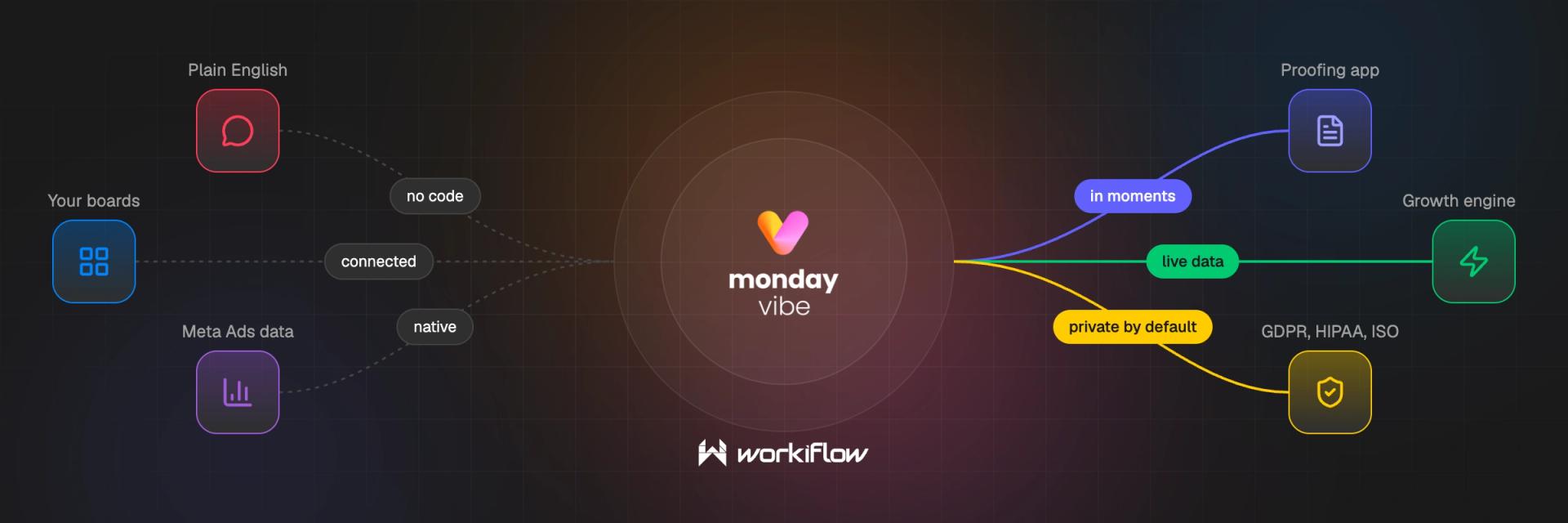
monday vibe is monday.com's AI-powered, no-code builder that turns a written prompt into a fully functional, secure custom app running directly on the monday.com platform. No code, no developer ticket, no six-week build queue. You describe what you need in plain English. Vibe builds an app connected to your actual boards and data, in moments.
It's open to any monday.com user on an account with AI activated, regardless of plan tier. Apps are private by default, visible only to the person who built them, and admins control who can publish an app for others to use, so nothing goes live account-wide by accident. It also works on mobile the same way it works on desktop. Every app runs on monday.com's own infrastructure, which carries GDPR, HIPAA, ISO, and AICPA compliance, keeping your data secure with advanced admin controls and enterprise-grade compliance.
That's the short answer. Here's what it looks like in practice, from the two apps we built.
Build 1: A Proofing App That Never Leaves the Board
Making the creative work is the fun part all marketers love, getting it all signed off usually isn't. Especially when feedback is scattered across email, Slack, and a PDF, nobody can agree on which is the final version.
So we followed a catalog spread, from upload to final sign-off, entirely inside a monday.com proof board. Every review type lives on the same board: catalog spreads, email covers, whatever the team is producing. Click into any item and the proof opens right in the item view, next to updates and files. Same board, same job, nothing new to log into; everything inside your monday.com board.
Inside the proof itself, there's a marking toolbar built exactly for marketers: a pin for "look here," a box to highlight a whole area, a text-replacement tool, and a measurement tool most people don't expect. Instead of arguing that a logo "looks off," you measure it and attach the brand book page that shows where it should sit.
Demo of a monday.com Vibe proofing app showing in-board markup tools, review rounds, and client sign-off.
Comments carry who wrote them, whether they're on your team or the client's, and which review round they belong to, tagged by design, copy, pricing, brand, or legal, so at the end of a round you can actually answer "was this a copy problem or a brand-guideline problem?" A compare tool lets you set two rounds side by side and see exactly what changed, version to version.
Review chains are fully configurable, sequential (one stakeholder at a time) or parallel (everyone at once), and clients don't need a monday.com login to take part. Share a link, they open it in a browser, mark it up, and it lands right back on the board.
All of the tools that a marketing team would use in the campaign cycle of proofing and hand off, accessible directly in your monday.com board.
Using monday vibe removes that extra layer of busy work having to switch to a separate proofing tool app. Everything from monday vibe to your board.
Build 2: A Growth Engine That Runs Off Real Pipeline Data
The second build we did had a bigger overall scope: a Vibe app the team named Marꓘeter (styled with a reversed K), built on top of monday's Pulse data and connected natively to Meta Ads.
The homepage gives a marketer all the numbers that actually matter: revenue breakdown, total leads, lead-to-conversion percentage, and return on ad spend. Any of those boxes can be opened up and expanded. Pipeline value breaks into qualified ARR versus prospective ARR and pipeline velocity. Leads break into qualified accounts, active prospects, and weekly intake. ROI breaks into Meta ad spend and payback period.
Demo of a monday.com Vibe marketing growth engine app with Meta Ads integration, lead scoring, and competitor comparison.
That homepage is just the entry point. Underneath it sits a full dashboard across four connected pages, Stats, Leads, Market Strategy, and Meta Rollout, each one informing the next:
- Stats shows pipeline capacity, qualification rate, and top lead-source strength, plus a running list of the hottest current leads.
- Leads goes client by client: a research brief, a lead score, full contact details pulled straight from the monday board, and a side-by-side comparison against your top competitors, shown as either a radar chart or a simple bar breakdown, whichever you read faster.
- Market Strategy scores every lead against your actual marketing pillars (elite fit, high fit, moderate fit) and explains why a lead scored that way, along with talking points to walk into the call with.
- Meta Rollout breaks down ad performance platform by platform: cost per lead, audience, age group, and a 7-day trend on leads and CTR, with specific suggestions on where to adjust spend.
Nobody built this to check once a month. It's meant to sit open during a live call, built for a team member to be able to check whenever they need. A real marketing growth engine built through monday vibe.
Why This Matters Beyond Two Demos
Neither of these apps started as a template. They started as plain English describing a real pain point in the team: approvals that drag on too long, and marketing data scattered across five tools instead of living where the campaigns actually run.
That's the difference your team will be able to feel in real time using vibe. The person closest to the problem can build the tool, without waiting on a dev backlog. And because it's built on monday.com's own enterprise infrastructure rather than a bolted-on tool, it doesn't create a new security review every time someone builds something. The compliance is already there with GDPR, HIPAA, ISO, and AICPA compliance.
The two builds you saw were built by the team at Workiflow. We're a monday.com Platinum partner, we don't just hand clients the software and walk away. We help figure out what's actually worth building, then build it with them inside monday.com, shaped around how their team already works.
The question isn't whether Vibe apps apply to your team. It's which workflow you'd fix first.
FAQ: monday.com Vibe Apps
What is a monday.com Vibe app?
A Vibe app is a custom application built inside monday.com using AI-powered prompts instead of code. It can be a full-page app, a board view, an item view, or a dashboard widget, connected directly to your existing boards and data.
Who can access monday vibe?
Any monday.com user on an account with AI activated, across all plan tiers. Apps are private by default, visible only to their creator, until an admin grants the "Publish vibe apps" permission to share them more widely.
Is monday vibe secure enough for enterprise use?
Yes. Vibe apps run on monday.com's existing infrastructure, which carries GDPR, HIPAA, ISO, and AICPA compliance, with admin-level control over who can build and who can publish.
Can a monday.com Vibe app be used for creative proofing and approvals?
Yes. A Vibe-built proofing app can run entirely inside an existing board. Reviewers mark up assets directly, comments are tagged by category and review round, and clients can approve work through a shared link without a monday.com login.
Can a Vibe app connect to marketing tools like Meta Ads?
Yes. Vibe apps can connect natively to platforms like Meta Ads and pull in monday.com board data (via Pulse) to build a live marketing dashboard covering pipeline, lead scoring, competitor comparison, and ad spend performance in one place.
Do you need to know how to code to build a Vibe app?
No. You describe the app you want in plain language, and monday vibe generates a working, secure app connected to your data.
Want to See What This Looks Like for Your Team?
You don't need to build a rocket ship to get value out of monday vibe — you need one workflow that's currently held together with email chains and hope. We'll help you find it and build it.