
On this page
Most companies that call themselves "global" meaning they have clients in a few different countries. We mean something more literal: somewhere on the Workiflow team, someone is awake, working, and moving your project forward, at almost any hour you'd care to check.
Plenty of businesses say "global team" and leave it there, we'll show you what ours means and how it's not the typical flashy business slogan.
The Real Numbers
Workiflow is a 30-plus person team that's delivered more than 2,000 projects, spanning seven countries: the United States, South Africa, Portugal, France, Uruguay, India, and Pakistan. We're 100% remote, and that's a deliberate structure, not a byproduct of convenience.
Where the Team Actually Is
Our company isn't run from one headquarters limiting our availability to you. Leadership is spread across the map too. Our Owners are in Peniche, Portugal and Jeffreys Bay, South Africa. Our Head of Sales is also in Jeffreys Bay, our Head of Finance is in Paris, and the team extends to Mumbai.
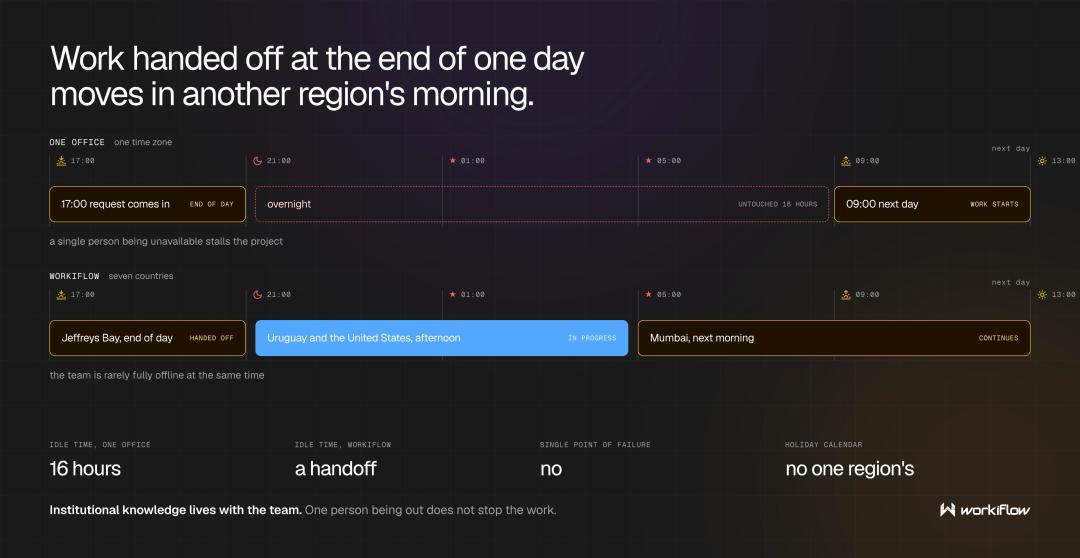
That spread means the workday doesn't stop when any one region logs off. Someone on the team is working while someone else is asleep, and the handoff between them is built into how we operate, not something we're improvising.
How This Became the Model, Not an Accident
Workiflow started in 2019 as two brothers, Keenan and JP Theron, who'd each already built solo freelance careers helping companies untangle badly implemented tech. By 2021, the team had grown to 15 people across three countries, and remote-first wasn't a pandemic-era adjustment for us the way it was for a lot of companies. It was a deliberate choice: hire the best operators for the job, regardless of where they happened to live.
That philosophy compounded. By 2022, the team had grown to 25 people across five countries. By 2025, we'd grown the team across six countries, and formally repositioned the business around a managed retainer model, because project-based, hand-off-and-disappear work never matched how clients actually needed us to show up.
What "Doesn't Sleep" Means for Clients
With team members across time zones, someone is always at the start of their workday when you need help.
- Fewer single points of failure. When institutional knowledge lives with a full team spread across time zones instead of one person in one office, a single person being unavailable doesn't stall your project.
- Faster turnaround on time-sensitive requests. Work handed off at the end of one region's day can move forward in another region's morning, instead of sitting untouched for 16 hours.
- Coverage that isn't dependent on any one region's holiday calendar or working hours. A team spanning the US, South Africa, Portugal, Uruguay, India, and Pakistan isn't fully offline at the same time very often.
The Trade-off Nobody Talks About
A distributed, global team isn't automatically better, it's only better if it's managed well. Poor async communication, unclear ownership, and handoffs with no documentation can turn "always covered" into "nobody's actually accountable." It's the main way a remote team goes wrong, so we plan for it.
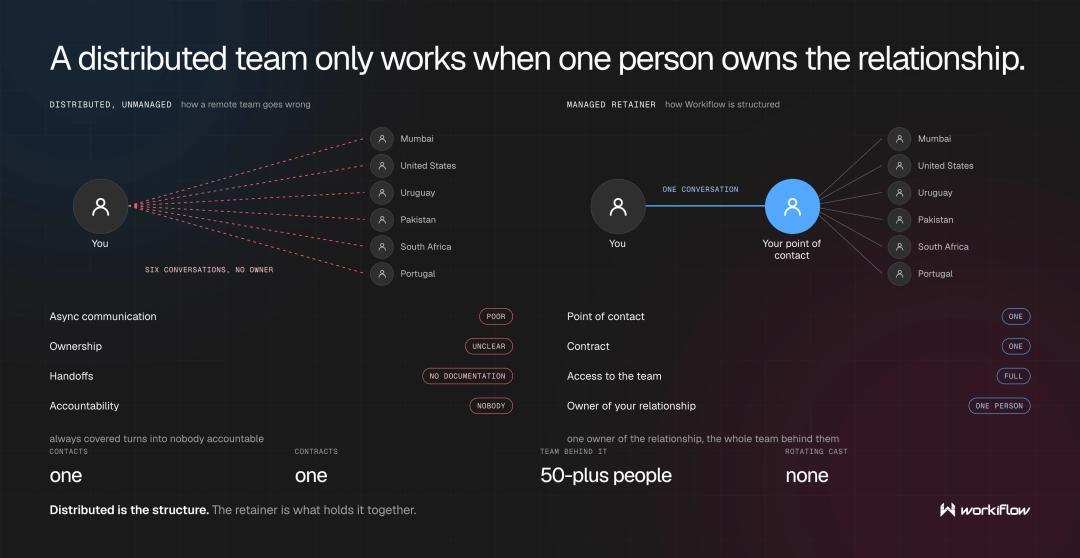
The way we've addressed that structurally is the same managed retainer model behind everything else we do: one point of contact, one contract, full access to the team behind it, rather than a rotating cast with no single owner of your relationship. Distributed doesn't mean disorganized when there's a real structure holding it together.
Where This Connects to Being a Managed Tech Partner
The real benefit is ongoing accountability instead of a one-time handoff. A global, always-covered team is what makes that promise operationally real, not just a line in a sales pitch. "We stay on" only means something if there's genuinely someone available to stay on.
If you want to see what working with a team like this actually feels like, book a free 30-minute consultation.
FAQ
Is Workiflow's support really available around the clock?
Not at a guaranteed instant-response level at every hour, but coverage extends well beyond a single region's business hours because the team spans seven countries and multiple time zones. Work is rarely fully stalled waiting for one region to wake up.
Where is Workiflow's team based?
Workiflow is a fully remote team of 30-plus people spread across the United States, South Africa, Portugal, France, Uruguay, India, and Pakistan. Leadership itself is distributed across several of those countries rather than concentrated in one headquarters.
Is a remote-first team the same as an outsourced team?
No. Workiflow's team is directly employed and integrated as one company, operating under a single managed retainer model rather than a separately managed outsourced vendor relationship. Remote-first was a deliberate hiring strategy to access the best talent regardless of location, not a cost-cutting outsourcing arrangement.
Does spreading a team across time zones slow down decision-making?
It can, if it isn't managed deliberately. Workiflow addresses this through a managed retainer structure with a single point of contact per client, so distributed work doesn't turn into unclear ownership.