On this page
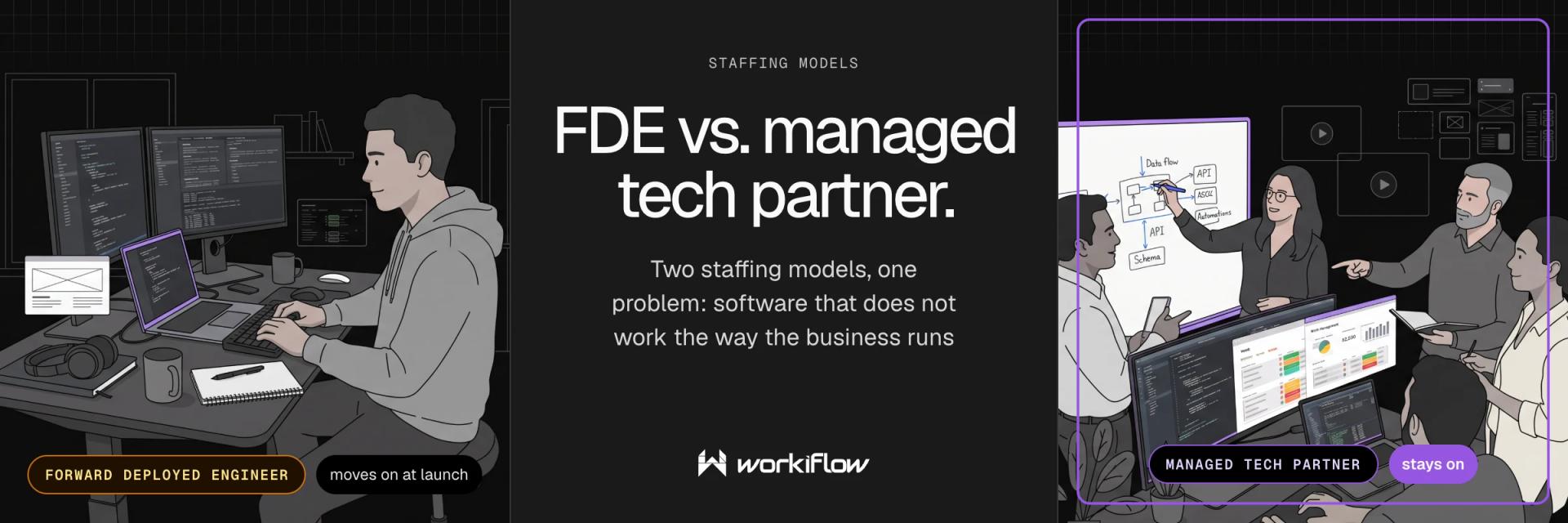
Two very different staffing models get pitched as the answer to the same problem: software that doesn't work the way your business actually operates. One sends an elite engineer to embed inside your company and build something bespoke. The other puts an accountable team behind your system, permanently, not just during setup.
Both work for different problems. Confusing them is how companies end up either overpaying for power they don't need, or under-resourcing a system that needed ongoing ownership from day one. Here's the actual difference, and how to tell which one your monday.com implementation needs.
What Is a Forward Deployed Engineer (FDE)?
A forward deployed engineer is a software engineer who embeds directly inside a customer's environment to build, customize, and deploy production software tailored to that specific business, rather than shipping a generic product and walking away. The model was pioneered by building early growth & strategy around sending engineers on-site to translate a client's messy problem directly into working software.
Job postings for the role have grown dramatically over the past year, by some measures multiplying several times over, as more AI-native companies adopt the model for enterprise deployments.
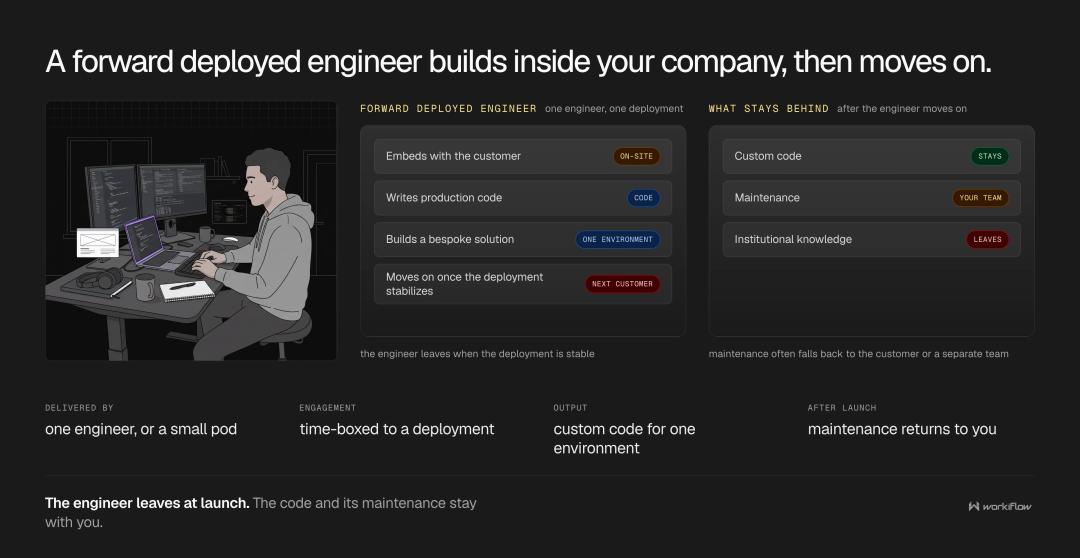
An FDE typically:
- Embeds with the customer, sometimes on-site, sometimes close to it, for the duration of a specific deployment.
- Writes production code, not just configuration, differentiating the role from a solutions architect or sales engineer who mostly demos.
- Builds bespoke solutions shaped around one customer's exact environment and constraints.
- Moves on once the deployment stabilizes, often to the next customer or the next hard problem.
What Is a Managed Tech Partner?
A managed tech partner takes a different shape entirely. Instead of embedding a single engineer to build something bespoke and then departing. A managed tech partner owns a business's core tech stack on an ongoing basis: implementation, integration, automation, and continued support, delivered not by an individual but a team. One that provides you with accountability that doesn't end at go-live.
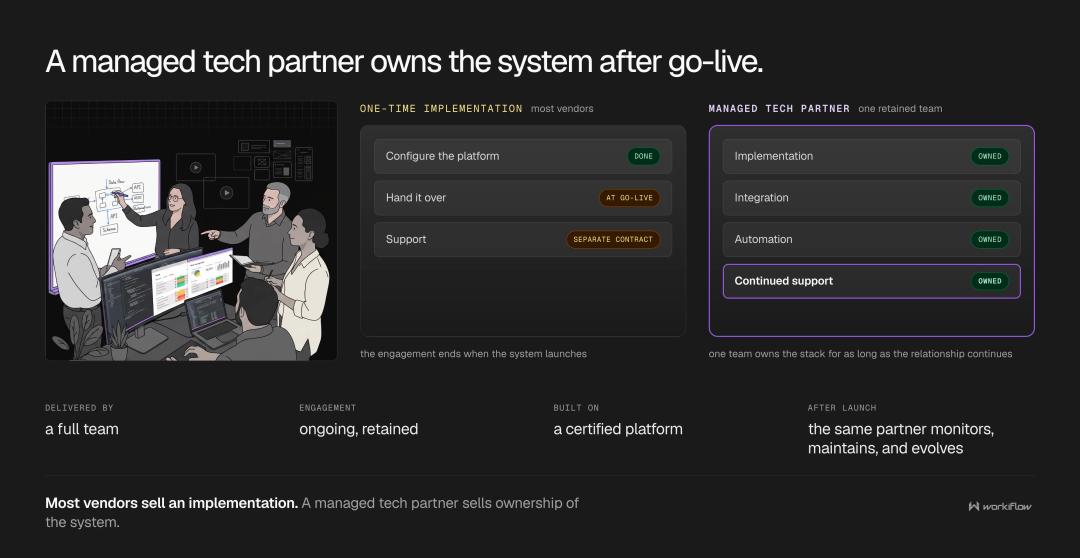
We've written about this model and common questions in our Managed tech stack glossary. The short version: most vendors sell an implementation. A managed tech partner sells ownership of the system, indefinitely, for as long as the relationship continues.
Side by Side
| Forward Deployed Engineer | Managed Tech Partner | |
|---|---|---|
| Engagement shape | Embedded, project-based, often time-boxed to a deployment | Ongoing, retained relationship |
| Who delivers it | Typically one engineer, or a small embedded pod | A full team: strategists, automation engineers, developers, AI specialists |
| What gets built | Bespoke, custom-coded solutions shaped to one environment | Configured and automated systems built on a certified platform |
| What happens after launch | Engineer moves to the next deployment; maintenance often falls back to the customer or a separate team | The same partner monitors, maintains, and evolves the system |
| Best suited for | Novel, high-complexity problems with no existing platform fit | Recurring operational workflows that a platform like monday.com can model well |
| Cost structure | High-touch, specialized talent, priced accordingly | Typically more accessible, spread across a broader team and platform efficiencies |
| Platform certification | Not typically tied to a specific certified partner ecosystem | Often backed by formal certification tiers (e.g., Platinum) that signal verified delivery quality |
Where the FDE Model Excels
Being fair here matters, because the FDE model isn't a lesser option, it's built for a different job. It makes real sense when:
- The problem has no existing platform that fits it. If you're building something genuinely novel, custom data infrastructure, a bespoke internal tool with no off-the-shelf equivalent, an embedded engineer writing original code is the right tool.
- The stakes justify dedicated, elite technical talent on-site. Government, and highly specialized enterprise deployments often need someone translating requirements in real time, in the room, with the authority to write production code on the spot.
- You're a company with the resources to absorb the tradeoff. One well-known critique of the pure FDE model, raised by product strategists who've studied its growth, is that it can produce a growing pile of bespoke, one-off solutions that all need indefinite maintenance. That's a fine tradeoff for a company with the engineering depth to carry it. It's a heavier one for most mid-market businesses.
Where a Managed Tech Partner Wins
A managed tech partner earns its place whenever the underlying problem is operational rather than novel, meaning a mature platform already exists that can model it well. That's true across most business software categories, not just one platform, and it changes the calculus in a few specific ways:
- The problem usually isn't novel enough to justify bespoke engineering. Most operational workflows, sales pipelines, project tracking, case management, service delivery & scheduling. Can be modeled well within an existing, mature platform's architecture, monday.com being one strong example. You're rarely solving a problem nobody's solved before.
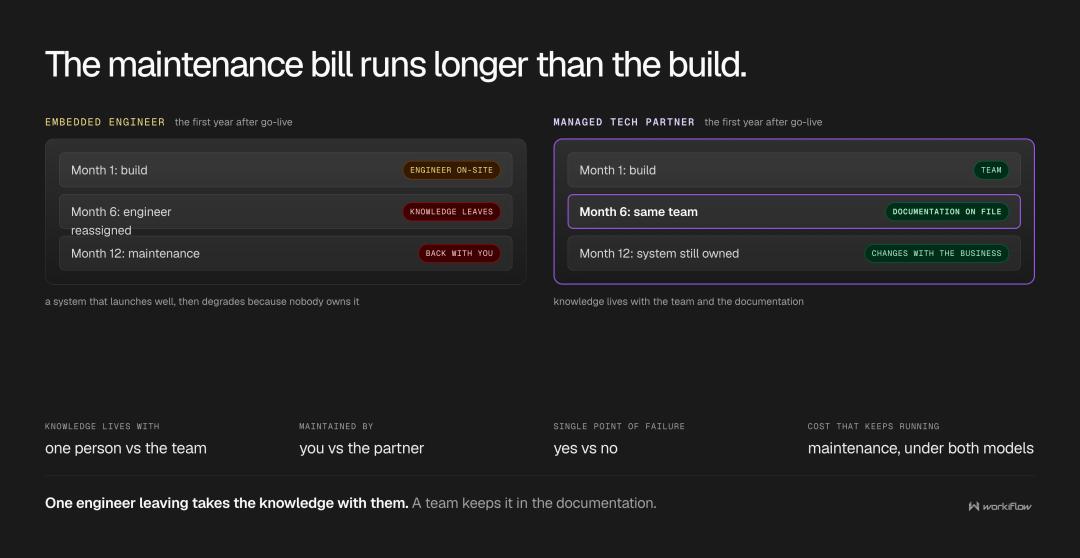
- Ongoing maintenance is the actual cost center, not the initial build. A system that launches well and then degrades because nobody owns it afterward isn't a win. A managed tech partner is priced and structured around staying accountable past go-live, which is exactly the gap the FDE model tends to leave open once the engineer moves on.
- You get a team, not a single point of failure. An embedded engineer who leaves, gets reassigned, or simply moves to the next client takes their institutional knowledge with them. A managed tech partner's knowledge lives with the team and the documentation, not one person.
- Certification signals verified delivery quality. Mature platforms with formal partner programs, tiered certification levels like monday.com's Platinum tier, that require sustained client satisfaction and proven complex-build experience, give buyers a layer of accountability the FDE model doesn't typically carry.
This applies broadly across CRM, project management, and operations platforms, not just one tool. We specialize in monday.com, but the underlying logic behind the managed model holds regardless of which platform sits underneath it.
How Workiflow Operates
Workiflow runs the managed tech partner model specifically for monday.com. We're a Platinum Partner, one of a small handful worldwide to jump straight from Silver to Platinum, skipping a tier entirely. With an in-house team spanning strategists, automation engineers, developers, and dedicated AI specialists, not a single embedded engineer who eventually rotates to the next account.
That matters most in the part of the relationship that happens after launch. A managed partner treats go-live as the midpoint, not the finish line, monitoring, adjusting, and supporting the system as the business changes, which is the entire distinction this article is built around.
Which One Do You Actually Need?
Ask these questions before choosing a model:
- 1.Does an existing platform already model 80% of this problem? If yes, lean managed tech partner. If no platform comes close, an FDE-style build might be warranted.
- 2.Does this need to work in six months without the original builder present? If the answer needs to be yes, ongoing accountability matters more than one-time technical firepower.
- 3.What's actually most expensive: today's build, or next year's maintenance? If it's the second one, and for most operational tech stacks, it is, a managed partner is structured around that cost, an embedded engineer typically isn't.
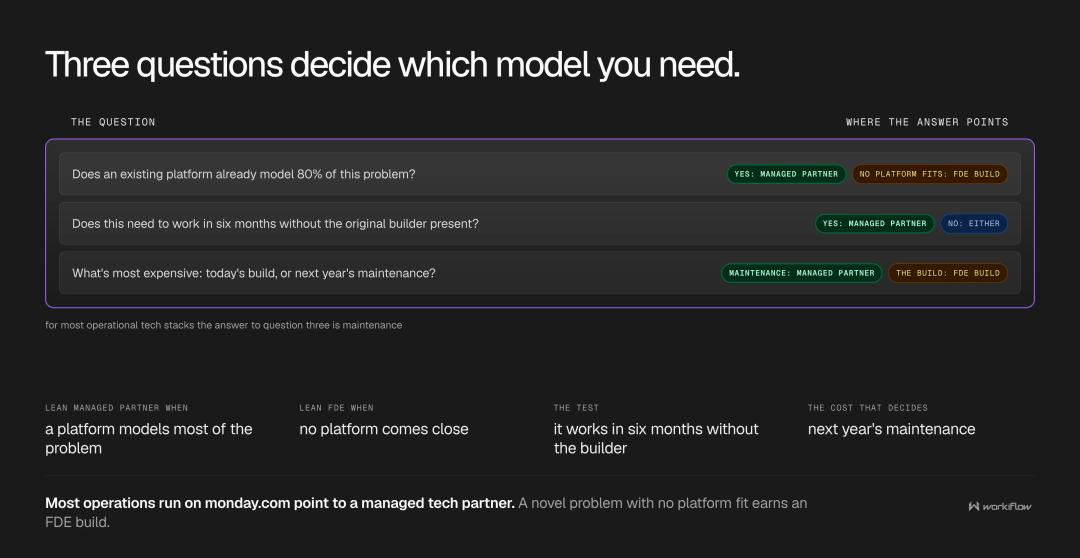
For most businesses running their operations through monday.com, the honest answer is a managed tech partner. For a genuinely novel technical problem with no platform fit, an FDE-style engagement earns its cost.
Book a free 30-minute consultation and we'll help you figure out your tech stack blocks and if a Managed tech partner is right for you.
FAQ
Is a forward deployed engineer the same as an implementation partner?
Not quite. A traditional implementation partner typically configures an existing platform for a client and then hands it off. A forward deployed engineer goes further, writing original, production-grade code tailored to one customer's environment, often for problems that don't have an off-the-shelf platform solution.
Can a business use both models at once?
Yes, though it's uncommon outside of large enterprises. A company might use an FDE-style engagement for a genuinely novel technical build while relying on a managed tech partner for its core operational platform, like monday.com, on an ongoing basis.
Is a forward deployed engineer more expensive than a managed tech partner?
Typically, yes, for comparable scope. FDEs are specialized, high-cost technical talent priced for bespoke, high-complexity work. A managed tech partner spreads cost across a broader team and platform efficiencies, which is usually more accessible for recurring operational needs.
Does the FDE model include ongoing support after deployment?
It varies, but the model is generally built around deployment, not indefinite maintenance. Once a deployment stabilizes, the engineer often moves to the next customer or project, and maintenance responsibility can shift back to the customer or a separate support function.