Getting Team Buy-In: The Psychology Behind monday.com Adoption
39% of employees say new technology roll-outs often create internal chaos rather than operational improvement.

Leads marketing at Workiflow, a monday.com Platinum Partner with 1,000+ implementations delivered across the U.S. and beyond.
Every organization invests in tools like monday.com with the promise of streamlined workflows, better collaboration, and faster results. But all too often… adoption stalls. Team members log in, poke around, then revert to old spreadsheets, Slack threads, or email chaos.
Despite sophisticated boards and shiny dashboards, the real value lies not in features — but in people using them. In this post, we'll explore the psychological and operational road-blocks that prevent full adoption, and give you a roadmap to drive real change.
Why Adoption is Rare
Corporations and teams may buy the software, without realizing the behaviour changes their team requires. For example:
- Over half of employees receive only basic training when new tools are rolled out — nearly one in five get little or none.
- One in seven employees has refused to use a new workplace tool entirely, and nearly 40% say roll-outs create chaos rather than improvement.
- Digital adoption initiatives often falter because of cultural resistance, inconsistency in processes, or lack of leadership sponsorship.
- These stats point to a fundamental truth: tools don't fail because of features — they fail because of people: how they feel, how they engage, how they trust the change.
Pro Tip
Set clear norms for when to use chat vs. meetings to reduce digital noise.
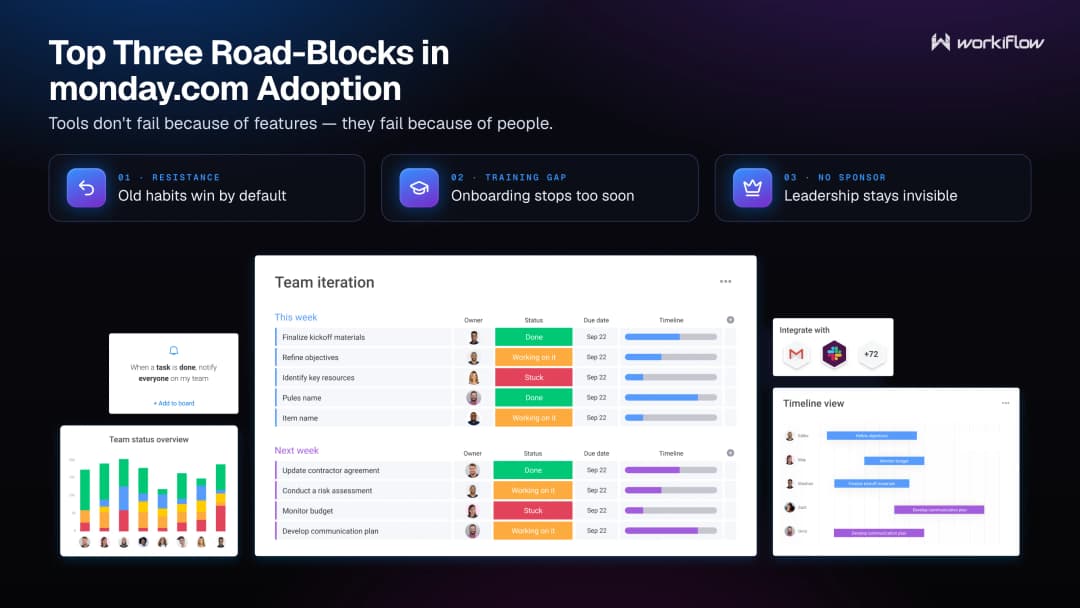
Top Three Road-Blocks in monday.com Adoption
Resistance to Change & Old Habits
Teams revert to what they are most familiar with. When the "why" is unclear, or the new system feels like extra work, resistance grows. As Forbes puts it: "Involve team members early, let them shape the tool, and they'll adopt out of ownership — not obligation."
Training Gaps & Poor Onboarding
Without training and ongoing support, even good systems stall. If only basic training is given (often 50%+ of the time), users don't feel confident and drift back to old methods, thinking they are being more efficient.
Lack of Leadership & Clear Value
When leadership doesn't visibly use or support the tool, teams don't either. And when users don't see how the tool improves their work — not just management's view — adoption fails.
Psychology Meets Process: How to Drive Full Adoption
- Make the "What's in it for me?" clear: Show each user how monday.com simplifies their work — not just management metrics.
- Select & pilot small teams first: Create early wins; once the pilot succeeds, it becomes proof, not a gamble.
- Provide ongoing, contextual training: Especially for advanced features like automations, AI, and integrations.
- Build feedback loops: Ask users what's working, what's not; adapt boards, dashboards, and training accordingly.
- Have visible champions (including leadership): When leaders use the tool publicly, it signals value — not just requirement.
From Insight to Action: Workiflow's Adoption Framework
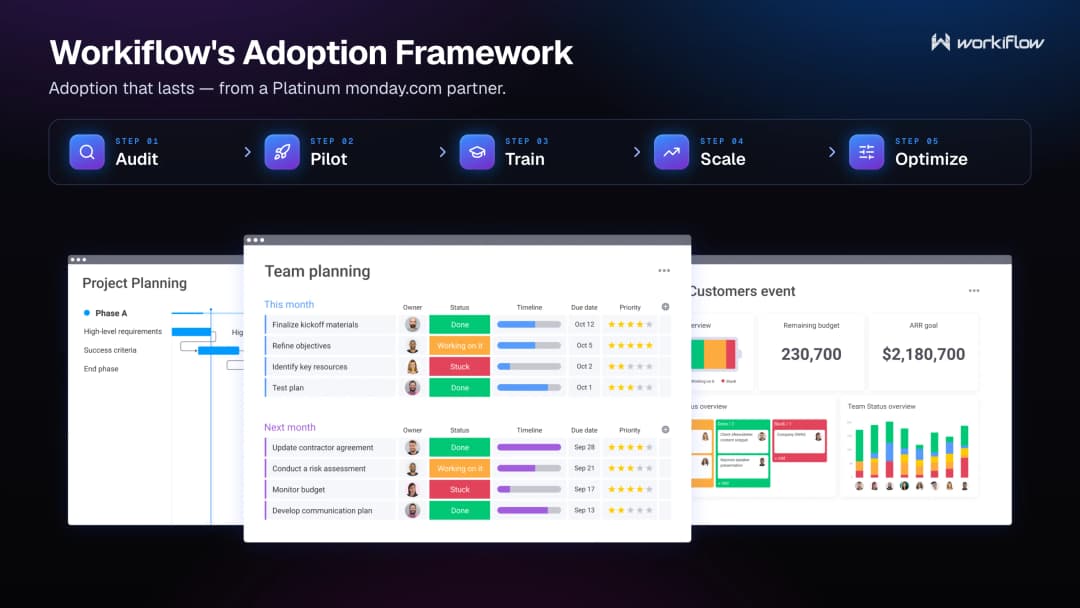
At Workiflow, we combine workflow expertise, change-management strategy, and platform proficiency as a Platinum monday.com partner to deliver adoption that lasts. Our methodology:
- /01Audit & map current workflows.
- /02Pilot and refine configuration with key users.
- /03Train, support, and measure adoption.
- /04Scale across teams.
- /05Optimize and iterate continuously.
If your team is ready to move from "we bought monday.com" to "we use monday.com every day and it works for us" — we're here to help.
Change can feel overwhelming. You may have bought the tool, configured boards, launched workflows — yet still hear the quiet question in the team: "Why am I doing this?" At the heart of adoption lies more than software — it's about trust, clarity, and meaningful benefit.
Workiflow has helped over 1,000 organizations turn adoption from a checkbox into a daily habit. Let's make monday.com not just implemented — embraced.
Book a Demo